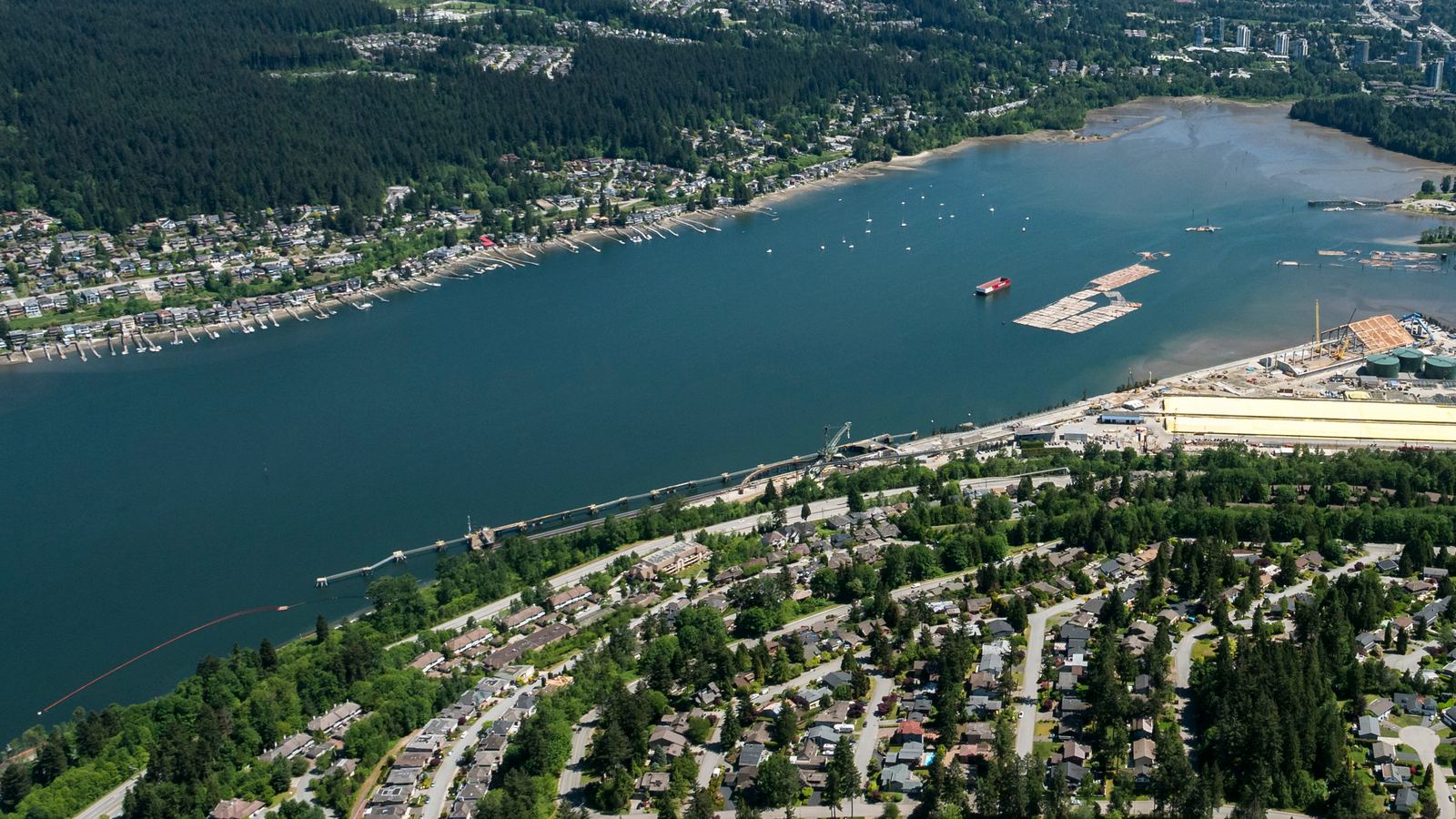
A truth that surprises most people researching a Port Moody multiplex: the zoning is usually the easy part. The conditions that genuinely shape projects here are physical, not political. Trees, slopes, creeks, and the pipes under the street decide more outcomes than any bylaw clause, and every one of them is knowable before a dollar is spent.
The tree canopy
Port Moody takes its trees seriously, and that canopy is part of what makes the city itself. The practical effect: significant trees on a lot are inventoried through an arborist report, healthy protected trees generally need to be retained or replaced, and root protection zones extend well beyond the trunk, constraining buildings, driveways, and trenching alike.
A large protected tree in the middle of a buildable area is a design constraint, occasionally a layout-defining one. Designers who work in Port Moody plan around trees routinely; the costly mistake is discovering a cedar's implications after paying for drawings that ignored it.
Creeks and riparian setbacks
Port Moody drains to the inlet through a network of creeks and ravines, some obvious and some running quietly behind fences. Watercourses carry riparian setbacks, protective no-build buffers under provincial and municipal rules, and they can meaningfully shrink a lot's buildable area. A property backing onto a green strip or a gully should treat this as a first-order question. Creekside lots still hold good projects; they hold them in a specific place on the lot.
Slopes and engineering
The grades that give Seaview and the mountainside neighbourhoods their views also give them geotechnical homework. Sloped lots commonly need engineering assessments, stepped or retained designs, and careful drainage, and costs rise with grade. Very steep or hazard-designated land can fall outside SSMUH entirely. Flat lots buy simplicity; sloped lots buy character. Both are legitimate purchases when priced honestly at the start.
Constraints usually become designs, not dead ends. A protected cedar becomes the courtyard the homes face. A creek setback pushes the building forward into deeper porches. A slope becomes the walk-out level a parent lives on.
The heritage layer
Older Moody Centre streets include a heritage character area, and a small number of properties city-wide carry formal designation or registry listings. Designation is a serious constraint; character-area membership is a softer one that shapes design expectations. A pre-war home, or a street that feels like a postcard, is reason to confirm status early. It changes the conversation more often than the outcome.
Servicing, the invisible condition
Water, sewer, and storm connections sized for one house may need upgrading to serve four homes, and on some streets the mains themselves are the question. This is the least visible constraint and, in practice, the most underestimated. It belongs in the budget conversation from day one, because discovering it at permit stage is how contingency funds disappear.
Reading a lot calmly
This list can make Port Moody sound like a hard place to build. It is more accurate to call it a specific place to build. Every condition above is checkable in advance from a desk, most are designable around, and plenty of lots carry none of them. The screen is part of the free feasibility study, alongside the paper checks described in the five feasibility checks. Most lots hide something. Few hide dealbreakers.
Common questions
Can the City require trees to be kept on a multiplex site?
Port Moody's tree rules require significant trees to be assessed by an arborist, and healthy protected trees generally need retention or approved replacement with new planting. Designs usually adapt around important trees rather than clearing them, and root protection zones constrain more than the trunk location alone.
How does a homeowner know if a lot has a riparian setback?
If a creek, ravine, ditch, or green corridor runs on or near the property, the question should be treated as live. Mapping gives a first read and a qualified environmental professional confirms the actual setback. It is a standard early check in any Port Moody feasibility review.
Are sloped lots excluded from SSMUH?
Most sloped lots remain eligible but need geotechnical assessment and adapted design, which adds cost. Land formally designated as hazardous can be excluded. An early engineering opinion is what separates a character slope from a problem slope.
Which reports does a Port Moody multiplex usually need?
Commonly a survey, an arborist report, and, depending on the site, geotechnical and environmental assessments. Servicing is reviewed through the permit process. A desk review of the lot indicates which reports are likely before any are commissioned, which is the correct order.